Prior to planning a public health intervention, it is imperative to conduct a needs assessment in order to directly learn from community members what their most relevant health issues are. Performing a needs assessment also allows researchers to learn more generally about the ‘day to day’ of the community, and the families within it, and gives them the opportunity to build rapport with community members. Though we simultaneously conducted health workshops addressing a couple issues that we were already informed were relevant to individuals in the community, one of our primary purposes during this first trip to Sierra Leone was to conduct assessment interviews with the community members and leaders. As a team, we were able to speak with over 50 children and 40 adults. Here are a couple personal accounts we gathered.
Thursday, July 31, 2014

Moses
One of the first people we are introduced to upon arriving to the Abigail D. Butscher Primary School is Moses Tholley. We are surprised to learn that Moses has been “preassigned” to assist with all of our public health activities during our time here. This is unexpected, since we were previously unaware of any such arrangement and assumed that we would be able to conduct our research on our own, but quite welcome, since Moses tells us that we would be unable to complete interviews by ourselves (though English is the national language, most adults who haven’t gone to school don’t speak English). As we introduce ourselves, I ask Moses if he “is a teacher here?” As Dr. Lovell walks past, he smiles at my innocent question and says “he basically runs this place!” Over the next couple weeks, we are fortunate enough to get a glimpse of just how special Moses is to the school, our project, his family, and as a person.
Moses teaches 6th grade at the Abigail school. He loves teaching this group of students because it makes him proud to see them well prepared to graduate and excel through their secondary education. As dedicated as Moses is to ensuring students succeed in the classroom, he also makes sure they’re having fun in school. He tells us about how he was taught by Peace Corps volunteers when he was younger, and how now he teaches the school children the same games and songs he learned while he was growing up (that’s how the kids already know row, row, row your boat!). One Friday, following the morning lunch break, Principal Koroma expects the children to return to their classrooms, but Moses (quite easily) convinces him that since it’s the last day of the week, they should get the rest of the day off as a “field day.” Though the children at school are always laughing and playful, we notice that that they are incredibly well disciplined as well. We share this observation with Moses one afternoon; he jokes that “they have to be well behaved because people like you from the US come to check up on us!” He emphasizes that they have to teach kids discipline and give them attention from when they are young so that they carry these values with them as they grow.
In addition to his responsibilities as a teacher, Moses facilitates every aspect of our research project, helping us coordinate our interviews, workshops, and evaluations, serving as an interpreter during conversations and presentations, and showing us around the community. Often, we see Moses staying late into the evenings to assist the Engineers with their work as well.
Moses cares for his six children as a single father on a modest income. I love that Moses’ son, Bai, who also used to teach at the school, tells us that his father is his best friend. Moses tells us that since his wife passed away, he has to remarry because without a wife, people will think he's not responsible. He tells us that he met his fiance (or “promised wife”) through striking up conversation with her at her stall in the market. :)
Not only is Moses a hard working, fun loving, committed leader in the school community, but these traits reverberate through his entire persona. One day, as we stand around and chat in the schoolyard, he points to a girl carrying a bucket of cupcakes on her head and says "When you're hungry, you might buy a hamburger. When I'm hungry, I eat this because I can't afford a hamburger" (I tell him I'm vegetarian but that's a different story). "Want what you have until you have what you want" is a motto Moses lives by. He tells us how he doesn't have electricity because not only would it cost him his entire month’s salary, but even if he could afford it, he would then want buy things to use the electricity, such as a TV or iron, and he definitely wouldn’t be able to afford these things. That's why, he says, he's happy with what he has.
As we leave, Moses tells us to share the pictures we have of him with anyone in the States who may want to be his friend or marry him. I remind him that he already has a fiancee but he says that football teams always have back ups, so why shouldn't he?

Madieu
 Not long ago, I didn’t know much more about Madieu Williams than what was listed on his Wikipedia page so traveling to Sierra Leone this June gave me the opportunity to learn more about Madieu’s extremely rich and personal relationship to our project. Madieu was born in Sierra Leone’s capital city of Freetown. His father left for the states when Madieu was only a few years old, and his mother left to join his father shortly thereafter. Madieu was raised by his grandmother till he was 8, when he joined his parents in Prince George’s County, Maryland. Madieu spent the rest of his childhood there, attending DuVal High School and subsequently choosing Towson University to pursue a degree and play football. A few semesters into college, when his family was going through a rough patch, he wound up having to take a lot of time away from his studies to chip in and care for his younger brother. One winter, feeling overwhelmed by all the changes in his life, he even contemplated dropping out of school. Around this time, he received an offer to join the University of Maryland football team. He accepted and eventually graduated with a degree in Family Science (in our very own School of Public Health!). Unfortunately, Madieu lost his mother to a stroke when he was only 21 years old. Madieu was eventually drafted by the Cincinnati Bengals and since then, has also played for the Minnesota Vikings, San Francisco 49ers, and Washington Redskins. He recalls that his parents never really “got” football, rarely expressing interest in wanting to attend one of his games. Before she passed, his mother told him that “Football is only the beginning; you’re meant to do so much more.” Recalling his mother’s advice, and wanting to give back to the communities where he spent his childhood, Madieu began the Madieu Williams Foundation in 2005. The foundation’s mission is to improve education, health, and fitness for underprivileged youth in both Sierra Leone and PG County. In Sierra Leone, the foundation focuses its efforts in the small rural village of Calaba Town, which was built after the civil war and hence lacks basic infrastructure. In 2009, the foundation funded the construction of the “Abigail D. Butscher Primary School,” named in honor of Madieu’s mother. When Madieu was barely 30 years old, he retired from football to focus his energy on the foundation. Since then, Madieu has partnered with the University of Maryland to facilitate projects with the school community; in 2002, the Maryland Sustainability Engineering (MDSE) team installed a solar array system to provide lights for the classrooms, principal’s office, bathrooms and the exterior of the school. Last January, the MDSE team traveled to Calaba town in preparation for building a secondary school across from the primary school building. Though Madieu has been traveling to Sierra Leone often over the last several years, this June was the first time his trip overlapped with the group from UMD. Over the two weeks, I was consistently impressed by how down to earth Madieu is: whether it be through making it a point to learn each of our names within his first couple days there, telling us about the cheesy pick-up line he used when he first met his wife,


Saturday, February 8, 2014
The 2014 Compone Implementation Trip: Hygiene Habits for Kids
A study of children's hand washing behavior in the region estimated that less than a third of children regularly wash their hands before eating and after using the bathroom (Lopez-Quintero, Freeman, Neumark, 2009). In the same sample, only seven percent had access to soap and clean running water at school. While our team didn't systematically measure hand washing behaviors in Compone, we could see the need staring at us from underneath nearly every child's fingernails. The community clinic director, Lucmilla, suggested that dental hygiene presented another educational opportunity.
The PHWB team organized children's health education activities at
the community health clinic, municipal building, and community meetings. Stephanie O. and Priya facilitated four
workshops reaching over a hundred children. Using songs, games, and hands-on practice, they taught children how to properly wash their hands and
brush their teeth. They led children in rousing renditions of "Lava tus manos," an instructional hand washing ditty sung to the tune of La Cucaracha. Shakira's "Waka Waka" marked the recommended two-minute toothbrushing timeframe, the last noble act of Priya's iPhone before it was stolen.
They also addressed clean water and water conservation, hoping to teach young people about the importance of water.
They also addressed clean water and water conservation, hoping to teach young people about the importance of water.


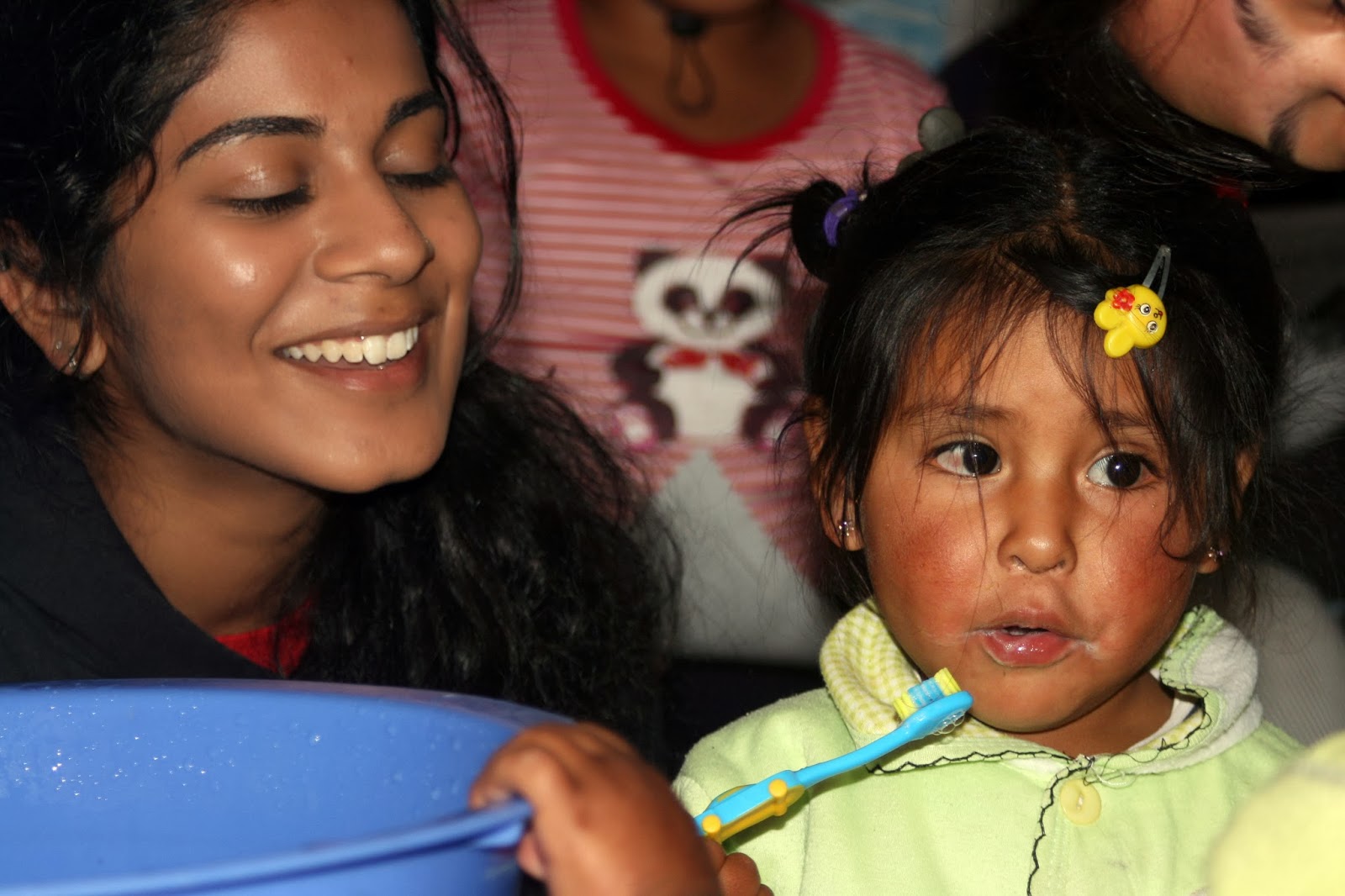


 |
| This photo shows the last of 10,000 times Stephanie and Priya led children in "Lava tus manos." |

The 2014 Compone Implementation Trip: Oral Rehydration Therapy
While Compone residents felt that water sanitation is important, the community president and others insisted that the water was already clean. The president described Compone's water as potable when, in fact, recent water tests showed levels of coliform well above recommended limits in all samples. In addition to the discrepancy between beliefs about water quality and actual measures, community members were more strongly concerned with water issues like flow rate, quantity, fairness in distribution, and conservation than with water quality.
Community members recognized that water often causes diarrhea, but the mechanisms through which water becomes contaminated were not well understood. Simple prevention strategies, moreover, were not often practiced. We were ourselves seldom able to access running water, soap, and a dry towel and never observed others washing hands. Outhouses are the norm in Compone homes.


Pigs, cows, sheep, water fowl, and dogs are everywhere in the community, their excrement scattered like little poop mines on the roads and paths and within living compounds. Little delineation between indoor and outdoor spaces cements the ubiquity of animal excreta, a new addition to my tiny Spanish vocabulary that I will never forget. When people do get sick, they told us the problem is easily solved by going to the nearby health clinic for medicine. The time and financial burdens of seeking treatment are so low, prevention is a low priority.


Although we had already planned to talk with households about water quality, these insights helped the PHWB team rethink our health education activities. Graciela and Greg facilitated four workshops with nearly 100 adults about water sanitation, preventing water-borne disease, and preparing oral rehydration therapy (ORT) or "homemade Gatorade," as it was known to the engineers. After demonstrating the simple ORT preparation, we distributed ORT recipes and liter containers to participants.


Community members recognized that water often causes diarrhea, but the mechanisms through which water becomes contaminated were not well understood. Simple prevention strategies, moreover, were not often practiced. We were ourselves seldom able to access running water, soap, and a dry towel and never observed others washing hands. Outhouses are the norm in Compone homes.
Pigs, cows, sheep, water fowl, and dogs are everywhere in the community, their excrement scattered like little poop mines on the roads and paths and within living compounds. Little delineation between indoor and outdoor spaces cements the ubiquity of animal excreta, a new addition to my tiny Spanish vocabulary that I will never forget. When people do get sick, they told us the problem is easily solved by going to the nearby health clinic for medicine. The time and financial burdens of seeking treatment are so low, prevention is a low priority.
 |
| That paragraph seemed like a good excuse to post some of my animal pics. |
 |
| Improving skills for a plan B career in shepherding. |
Although we had already planned to talk with households about water quality, these insights helped the PHWB team rethink our health education activities. Graciela and Greg facilitated four workshops with nearly 100 adults about water sanitation, preventing water-borne disease, and preparing oral rehydration therapy (ORT) or "homemade Gatorade," as it was known to the engineers. After demonstrating the simple ORT preparation, we distributed ORT recipes and liter containers to participants.
Monday, February 3, 2014
The 2014 Compone Implementation Trip: Community Work Day
Since the worksite is located at the top of a mountain,
moving materials for the project proved challenging. With the community president promising 30
helpers, a community work day was organized.
Our team was cautiously optimistic that a substantial number of people
would show up, but we feared solid days of carrying materials ahead if they
didn’t. Due to the efforts of community
leaders and Graciela, 47 community members arrived to help! People, young and old, carried a cubic meter
of sand, a cubic meter of gravel, over 200 cinderblocks, several one
hundred-pound bags of cement, and an enormous water tank up to the site. This volume of materials really helped us understand what the air at 12,000 feet is like.


 |
| Half way up the hill! |

Meanwhile, others excavated the site to make room for the materials and the chlorination system, digging for over five hours.


The community work day was a success, enabling the
engineering team to pour a concrete pad the next day. The work day also resulted the second of
several community meetings about the project.
This meeting produced a commitment of several volunteers per day to the
engineering team’s construction efforts, and the community members voted to
fine households that didn’t help out!

Subscribe to:
Posts (Atom)