Pages

Saturday, February 8, 2014

The 2014 Compone Implementation Trip: Oral Rehydration Therapy

While Compone residents felt that water sanitation is important, the community president and others insisted that the water was already clean.  The president described Compone's water as potable when, in fact, recent water tests showed levels of coliform well above recommended limits in all samples.  In addition to the discrepancy between beliefs about water quality and actual measures, community members were more strongly concerned with water issues like flow rate, quantity, fairness in distribution, and conservation than with water quality.  

Community members recognized that water often causes diarrhea, but the mechanisms through which water becomes contaminated were not well understood.  Simple prevention strategies, moreover, were not often practiced.  We were ourselves seldom able to access running water, soap, and a dry towel and never observed others washing hands.  Outhouses are the norm in Compone homes.


Pigs, cows, sheep, water fowl, and dogs are everywhere in the community, their excrement scattered like little poop mines on the roads and paths and within living compounds.  Little delineation between indoor and outdoor spaces cements the ubiquity of animal excreta, a new addition to my tiny Spanish vocabulary that I will never forget. When people do get sick, they told us the problem is easily solved by going to the nearby health clinic for medicine.  The time and financial burdens of seeking treatment are so low, prevention is a low priority.

That paragraph seemed like a good excuse to post some of my animal pics.

Improving skills for a plan B career in shepherding.

Although we had already planned to talk with households about water quality, these insights helped the PHWB team rethink our health education activities.  Graciela and Greg facilitated four workshops with nearly 100 adults about water sanitation, preventing water-borne disease, and preparing oral rehydration therapy (ORT) or "homemade Gatorade," as it was known to the engineers.  After demonstrating the simple ORT preparation, we distributed ORT recipes and liter containers to participants.  


Monday, February 3, 2014

The 2014 Compone Implementation Trip: Community Work Day


Since the worksite is located at the top of a mountain, moving materials for the project proved challenging.  With the community president promising 30 helpers, a community work day was organized.  Our team was cautiously optimistic that a substantial number of people would show up, but we feared solid days of carrying materials ahead if they didn’t.  Due to the efforts of community leaders and Graciela, 47 community members arrived to help!  People, young and old, carried a cubic meter of sand, a cubic meter of gravel, over 200 cinderblocks, several one hundred-pound bags of cement, and an enormous water tank up to the site.  This volume of materials really helped us understand what the air at 12,000 feet is like.


Half way up the hill!


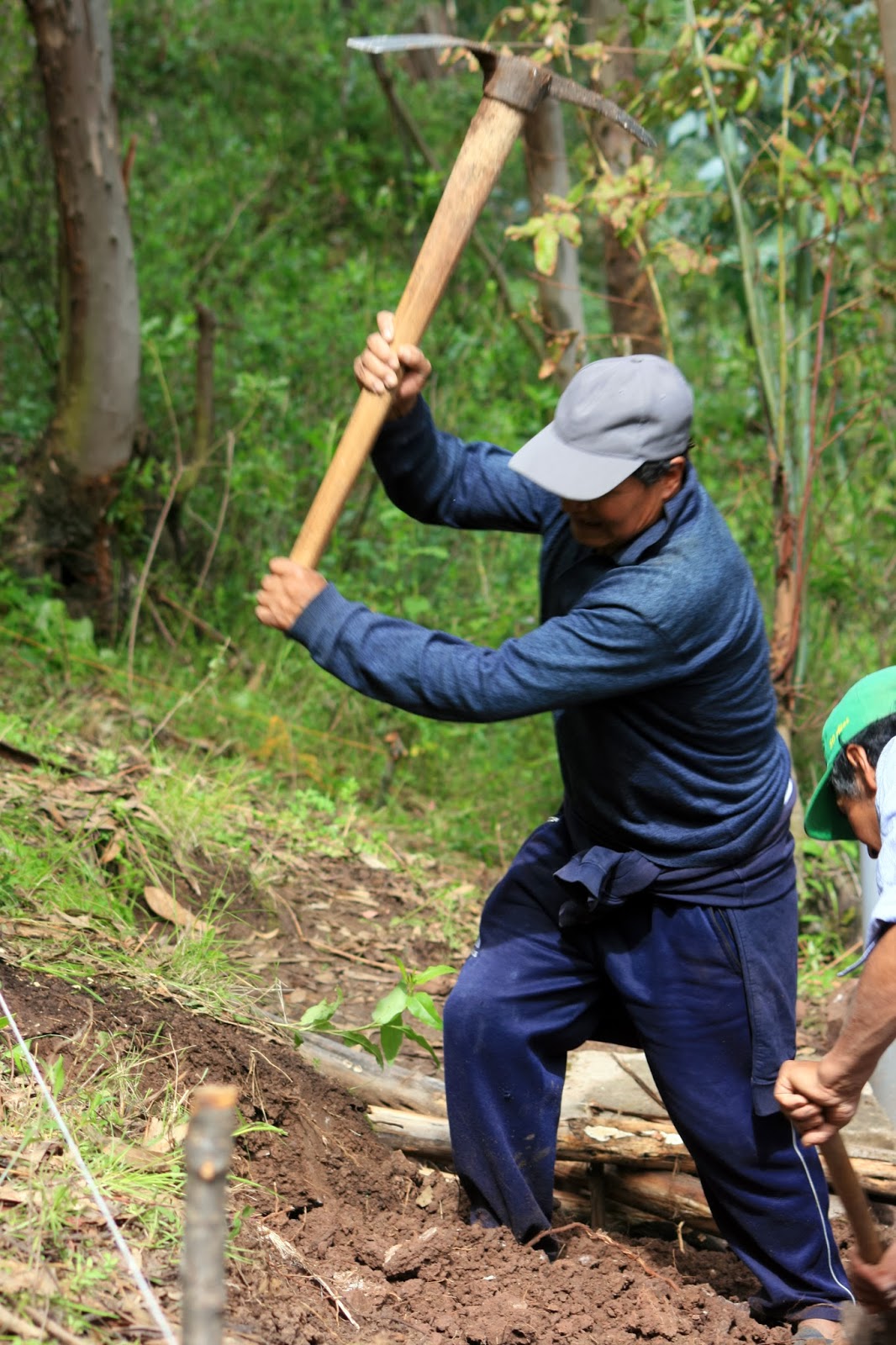
Meanwhile, others excavated the site to make room for the materials and the chlorination system, digging for over five hours.


The community work day was a success, enabling the engineering team to pour a concrete pad the next day.  The work day also resulted the second of several community meetings about the project.  This meeting produced a commitment of several volunteers per day to the engineering team’s construction efforts, and the community members voted to fine households that didn’t help out!


The 2014 Compone Implementation Trip: Meet the Team


The University of Maryland chapter of Engineers without Borders has been involved in water system and purification efforts in Compone, Peru, a small town in the Andes of Southern Peru, since the spring of 2008.  (Click here for a thorough project history).  Over the course of the last several years, the chapter worked to improve irrigation channels and minimize water loss in the community.  The water, however, remained unsafe to drink, as the chapter was not successful in building a disinfection system. 

After years of preparing multiple design solutions, the 2014 implementation trip resulted in the successful installation of a chlorine water disinfection unit in Ayllu San Isidro water district of Compone.  A group of over 70 students and faculty worked to design and test a solution during the fall 2013 semester.  Many students and advisors prepared implementation plans: Achal Amin, Joe Andrews, Brian Avadikian, Sean Bagnall, Jordan Cassell, Hyunjo Choi, Maria Coelho, Mateus Coelho, Addison Goodley, Kevin Hogan, Kelly Hogenson, Abby Iacangelo, Delaney Jordan, Bhumibhat Kerdsuwan, Elisabetta Lambertini, Kelly Latham, Zachary Lawrence, David Marin, Ed Miller, Dominick Montero, Mike Nociolo, James Pokodner, Nelson Quispe, Jon Tseng, Ben Tunick, and Caislin Wheeler.  

Six engineers traveled to Peru in January to execute the project team’s plans:


Jordan Cassell is a sophomore civil engineering major.  Jordan will serve as the Project Leader for the Compone project starting in February 2014.
Jordan’s Compone Superpower: Tallest woman in Peru.  Also, calculations.


Juan Cruz is a sophomore electrical engineering major.
Juan’s Compone Superpower: Bargaining for hardware supplies nearly every day.


Kevin Hogan serves as the Project Leader for the Compone EWB project.  He is a senior computer engineering major.   Kevin previously traveled to Compone for the 2013 assessment trip and worked tirelessly to lead the project team in development a feasible solution.
Kevin’s Compone Superpower: Fearless leader.  Also, low culinary standards. 


Abby Iacangelo is a junior biomedical engineering major. Abby also serves as the EWB-UMD chapter Vice-President. 
Abby’s Compone Superpower: Pound-for-pound weightlifting champion.


John Tseng is a junior computer science major and also serves as the EWB-UMD chapter Webmaster.
John’s Compone Superpower: Reducing three weeks worth of work in a two-minute time-lapse. Also, eating contest titleholder.


Dr. Bart Forman, Assistant Professor in the Department of Civil and Environmental Engineering, is a Faculty Advisor and Professional Mentor for the Compone EWB project.
Bart’s Compone Superpower: “Historical” references. Also, coffee procurement.


The 2014 implementation trip also marks the second time that EWB-UMD has traveled with a Public Health without Borders team.  The Maryland PHWB team prepared community organizing and health education activities to compliment the construction of the chlorination system.  A team of seven sophomore Global Public Health Scholars students (Hannah Asmail, Cinthia Ennaco, Ali Jourabchi, Stephanie Olcese, Priya Parikh, Kamran Partovi, and Joshua Trowell) worked with faculty and graduate students to develop a safe water curriculum for children and educational materials for adults.  Faculty and graduate students also prepared a community mapping interview protocol and evaluation tools.  The following individuals traveled to Peru for the 2014 implementation trip:

Graciela Jascheck is a doctoral candidate in epidemiology and biostatistics.  Graciela previously traveled to Compone during the 2013 assessment trip and frequently served as a translator for the group. 
Graciela’s Compone Superpower: Diplomatic relations.

Stephanie Olcese is a sophomore neurobiology major and Co-Founder of the Public Health without Borders student group. 
Stephanie’s Compone Superpower: Piñata destruction.  Also, best boots.

Priya Parikh is a sophomore individual studies major focusing on global health.  She is also a Co-Founder of the Public Health without Borders student group. 
Priya’s Compone Superpower: Hand-washing sing-along captain.

Greg Raspanti is a doctoral student in environmental health and toxicology.  Greg  previously traveled to Compone during the 2013 assessment trip. 
Greg’s Compone Superpower: Kitten whisperer.

Dr. Stephanie Grutzmacher, Research Assistant Professor in the Department of Family Science, is a Faculty Advisor for the Compone public health team. 
Stephanie’s Compone Superpower: Not dying.