Pages

Monday, February 9, 2015

Rapid Development in Ethiopia's Amhara District

Written by Jenni Young

One of the first things I noticed upon my arrival in Ethiopia was scaffolding. Scaffolding made of thin eucalyptus trunks wrapped precariously around enormous empty concrete structures. The blocks around our hotel in Bole were littered with half-constructed high rises and sidewalks covered with sand, dirt, and rocks. These signs of skyward movement were just one indicator of how quickly Ethiopia is developing…one of many that I observed. 

The city of Addis Ababa is building its’ first light rail which is to run north to south and east to west, connecting the city’s sprawling population. One hot highland day we decided to take a trip to a beautiful lakeside resort and hired a van and driver to take us there as well as a few other touristy sites. On the way out of the capitol, we hit a crowd of standstill traffic. Hundreds of busses packed with people, double loaded semi-trucks, and family-sized economy cars alike were stuck in the dusty heat for over two hours. We later learned that this traffic jam was unusually long but was partially the result of detour around a giant highway construction project that was being undertaken by the Ethiopian government. The massive and empty four-lane highway was a stark contrast from the crowded dirt road that served as the temporary on-ramp. 

Other surprising sights included brand new tolls booths erected next to wooden huts on the side of the road, and a city comprised of almost completely finished apartment buildings that was completely, and eerily, uninhabited. Even the university campus that we visited in Debre Berhan was showed signs of rapid development. Debre Berhan University covers a sprawling area of hillside with brightly colored school buildings and cobblestone pathways. The university itself is only seven years old, but the number of students enrolled has soared to 18,000 individuals. I was pleased to see the spacious campus because its continued construction and bustling student life represented an optimistic outlook on the growth of the university and the emphasis on building a reputation as one of the best colleges in Ethiopia. 

Despite the modernity and rapid development that I witnessed in Ethiopia, there is a beautiful juxtaposition of old and new in all of the construction. The campus buildings still seemed to be made of a mixture of straw and cement, the cobblestones were hand cut by local students and workers, the construction of 10-story buildings still relied on eucalyptus tree truck scaffolding wrapped with twine and hand-mixed concrete. Rarely would I see a construction crane or cement mixing truck. The lesson I learned through these observations is that Ethiopia is definitely pushing forward structurally, economically, and societally, but it still retains many traditions and elements of its beautiful culture through the use of local products and ancient practices.


Community-Based Team Projects in Debre Berhan

Written by Jesse H. Wilson III

In Ethiopia, abundant development and cultural traditions and roots are mixing. Debre Berhan is an exceptional example, a rapidly growing city nestled among the mountains and  farmland that characterize its recent past. Since the founding of Debre Berhan University (DBU) just seven years ago, the once-small farm town is growing faster than ever. 

The growth in the city is perfectly reflected just through the gates of DBU, in its speedy construction and devotion to the quality of its education amidst rapid increases in student enrollment. The students and staff are as resilient and eager as any to learn and grow while working towards the development of their city and nation. What drives these individuals is the goal to one day contribute all they can to their families, communities, and Ethiopia as a whole. Many seek to become medical doctors to prevent disease and bring efficient and accessible healthcare to all Ethiopians. Others seek to strengthen the economy, infrastructure, or government. But all exhibit a national pride that rivals any other. 

The DBU administration and faculty we met place a high value on research and community service, making it a general requirement for all public health students and a core responsibility of faculty and staff. In brainstorming ways that UMD PHWB students and DBU students could work together, one specific DBU program expresses the most compatibility for collaboration. The Community Based Team Project (CBTP) in the College of Medicine and Health Sciences is a practicum course for 3rd year public health students that trains them to apply their knowledge of community health issues such as nutrition, disease prevention, and sanitation. The program incorporates research techniques, data collection, analysis of community strengths and needs, intervention development and implementation, and evaluation. This comprehensive program is everything that the PHWB team could wish for. 

When PHWB returns in the late spring, the students at DBU and UMD will work in tandem in the community of Debre Berhan to prevent malnutrition. Both the PHWB team and DBU are extremely excited to be working together on this project. But I believe that the team is most excited to contribute to the development of this flourishing community.


Visiting Debre Berhan and Debre Berhan University

Written by Anthony Slaton

Our trip to Ethiopia was not only a wonderful experience, but it also opened my eyes to the importance of public health at a global level. Thought my interactions with families, teachers, professors, and students, I witnessed how public health has the potential to make a difference in these communities. 

Public Health Without Borders is working in Debre Berhan, a town located 130km north of Addis Ababa. In Debre Berhan, stores that lined the streets were made of corrugated steel or simply pieces of plastic propped up on sticks. Our very modern hotel created a drastic juxtaposition with the homes that surrounded it. In the streets, donkeys and cows walked freely. Without traffic signals, the animals, Bajajes, and trucks flowed in all directions. With only one hotel and a few restaurants in the town, I decided that tourism must not be common in Debre Berhan. However, the town seemed to be thriving. The market areas had plenty of vendors selling goods to dozens of patrons at any given time. The university campus is dotted with fully and partially constructed buildings. Debre Berhan and Ethiopia as a whole seem to be developing at an extremely fast pace.

Debre Berhan University, located in the center of Debre Berhan, is our project partner. In a very short period of time, this university has been able to create a system able to educate 18,000 students and also conduct research at an impressive level. This has been possible because of their optimistic and dedicated faculty. We hope to collaborate with these students and faculty in the future to develop a public health intervention to tackle malnutrition in the surrounding community. In the planning of this intervention we were lucky enough to meet with 2nd and 3rd year public health students while visiting the university.

Meeting these students and visiting the university was the highlight of my trip. The perspective and enthusiasm they had for their education has changed the way I view my own education. When speaking with 2nd year students, we asked them why they wanted to go into public health. They all proceeded to tell us how they wanted to solve the problems that were facing their communities. In particular, one student responded by saying “for the love of my country and people.” When this same question was asked in my introduction to public health course at Maryland, most students responded by explaining what they wanted to do in the future. Whether it was becoming a doctor, getting a Master's, or just simply getting a job in public health, nobody responded by saying they wanted to use this education to address challenges in their communities as the students in Ethiopia had.

Working with these students helped my realize how lucky I am to be in a situation where I can get an education that will not only open doors for me in the future, but also give me the skills to make difference in the global community and in my own community. My perspective has been changed from viewing my undergraduate education as a stepping-stone into higher education to an opportunity to use my education to make a difference.

Friday, February 6, 2015

PHWB Ethiopia - Meet the January 2015 Travel Team

In the fall 2014 semester, Public Health without Borders launched a new project in Ethiopia. With the help of two mentors who are working to build a collaborative outreach project between the agriculture colleges at University of Maryland and Debre Berhan University, PHWB students began planning for a January trip to Ethiopia.

Prior to leaving, the new Ethiopia PHWB team planned a needs and strengths assessment centering on issues of child malnutrition in the Amhara region. While the team wasn't sure how their goals and plans would change once they met their Debre Berhan public health collaborators, they were prepared to interview public health faculty and students, community leaders and members, extension workers, health workers, and other key stakeholders.

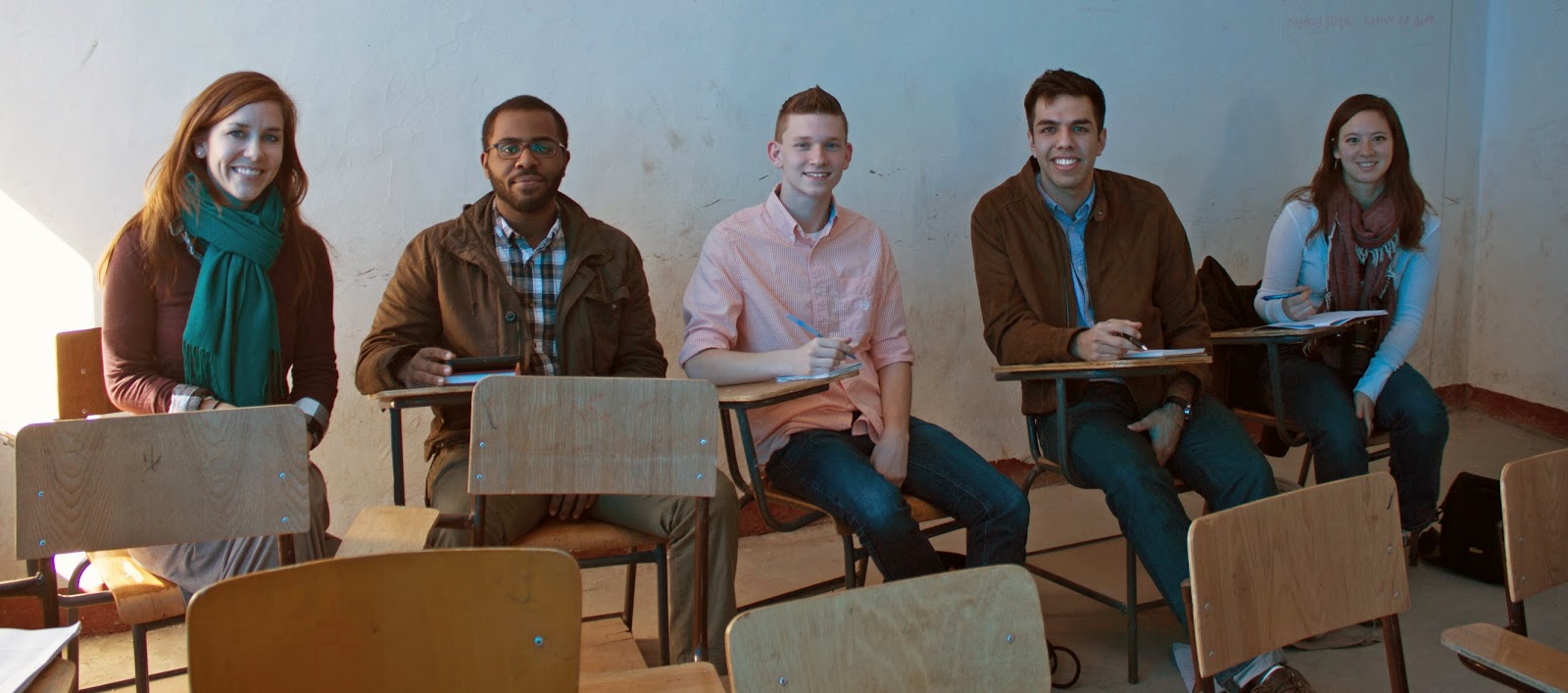
A group of six traveled to Debre Berhan, Ethiopia in January to explore the possibility of collaborating with Debre Berhan University faculty, staff, and students on a community outreach project:

Dominic Hosack is a first year PhD student in the Department of Behavioral and Community Health at the University of Maryland, College Park. His research interests center around nutrition, food security, and urban agriculture. He is currently a research assistant for the Community Health Awareness, Messages, & Prevention (CHAMP) lab.  In this role, Dominic is involved with various community-based participatory projects including a cancer screening program at African American churches in Prince George's County.  Dominic is also involved with Public Health Without Borders as a Graduate Mentor.  Lastly, Dominic is a member of the Maryland Community Research Advisory Board (MD-CRAB) and collaborates with community stakeholders to create evidence-driven and culturally appropriate interventions and research projects within Prince George's County.

Anthony Slaton is a third year undergraduate student at the University of Maryland, College Park and serves as the Project Leader for PHWB Ethiopia.  He is majoring in Public Health Science with the aspirations of pursuing a medical degree once he graduates.  While he has always had a love for traveling, his first trip to Ethiopia has opened his eyes to the rewards of working in global health.  He cannot wait to return to Ethiopia to continue the work Public Health Without Borders is doing there.   

Jesse Wilson is a first year undergraduate studying biological science and Chinese. He plans to attend medical school after completing his Bachelor’s degrees. In the past, he has traveled around the United States and Spain. As he had only been to Africa once before on a day trip to Morocco, this trip was his first time to the Horn (of Africa), and he enjoyed every minute.


Jenni Young is a first year PhD student in the Department of Family Science and a Graduate Mentor for PHWB. She has previous lived abroad in Beijing, China and traveled to countries in Southeast Asia and Europe. Her research interests include interracial families, communication styles across cultures, and the development of family therapy interventions in international settings. She has completed a Masters of Art in Chinese language and culture, as well as a Masters of Science in Couples and Family Therapy. This trip to Ethiopia was her first time in visiting an African country (besides a day trip to Morocco) and she loved learning bits of Amharic, participating in coffee ceremonies, and watching donkeys walk themselves down crowded streets.

Hiwot Menbere is a retired University of Maryland Extension horticulturalist and consultant to the College of Agriculture and Natural Resources Women in Agriculture project in Ethiopia. Born and raised in Ethiopia, Hiwot came to Maryland with his young family in his early adulthood. He also runs the non-profit organization Good to Grow, which aims to provide school and community gardens and nutrition education as a means to improve nutrition in vulnerable Ethiopian communities. Hiwot is committed to supporting agricultural development and public health capacity-building programs in Ethiopia.

Dr. Stephanie Grutzmacher is a Research Assistant Professor in the Department of Family Science and the Faculty Advisor for the Ethiopia project. She previously worked on the Women in Agriculture project in Afghanistan, advised the PHWB Peru team, and has traveled with students to the Bahamas, Peru, and Ecuador as an Alternative Breaks advisor. Stephanie's research and outreach work focuses on innovative school and community strategies to improve dietary quality and food security in the United States and abroad.

Stay tuned for reflections from our trip!

Tuesday, September 9, 2014

Three Miles to the Clinic; Walking with Moses

As we huffed and puffed to climb the ups and down of the gravelly and rocky paths, Moses easily glided ahead of us with his crisp white shirt and sturdy hiking shoes. Walking through Allentown and Calaba Town, I was most struck by the variety of homes that were haphazardly arranged up the mountain. While the vast majority were of concrete foundation with corrugated metal for walls, there was the occasional large compound with high concrete walls armed with barbed wire and broken beer bottles cemented to the top. These contained huge, lavish homes that starkly contrasted with the modest, community-built homes. As we walked, it didn’t matter if it was a corrugated metal and concrete house, a large and lavish home or a tarp and wood shack, Moses led us straight through all of them, jumping over deep irrigation channels, ducking through the trees that spotted our path or walking past groups of people chatting out in front of their houses. Our intention for this walk was to experience the three mile hike that it would take any sick person (or pregnant woman for that matter) to get to the nearest clinic for treatment. The further we walked though, the harder it was to imagine to get to the clinic if you were going into labor. To get to the clinic, we walked about two miles of path that cut through houses, and then about a mile through a loud, crowded market. This market was incredible, it was absolute sensory overload! Every five feet was a new stall with brightly colored small peppers, smoke dried fish and eel, fresh fish, chicken feet, cassava and groundnut leaves, rice, bulgur, beans, medicinal herbs, foam soap, cloth, and other little trinkets. Essentially, every stall was selling the same things, but there was new vibrancy with each stall and each vendor was just as excited as the next to show off his or her goods. None of the roads in Allentown or Calaba Town is paved, but it was especially evident in the market because it was situated on flat land, as opposed to the incline of the rest of the roads we walked along. Because of the lack of opportunity for drainage, most of the road was covered with puddles of mud that the passenger vans and motor bikes splashed right through.
Home in Allentown.

Home in Allentown.


Entering the Calaba Town market.

Smoked dried fish.

Okra, persimmon and eggplant.

Typical stall in the market.

Rice and bean stall in market.
          Once we got to what seemed like the end of the market, we reached the clinic. At the entrance was a group of three men sitting on the porch area and they welcomed us graciously, and once we entered we were escorted straight to the doctor’s consultation office. The whole clinic that serves three large communities consists of a waiting room that could fit around 40 people with two adjoining rooms, both for consultation.  A walkway crossed outside to two enclosed maternity rooms for delivery. We talked for a half hour with Zaynab, the clinic doctor, before she excused us out so that she could tend to her patients. She discussed the need for prevention education because of the number of people that come into the clinic with problems that could have been lessened or avoided with preventative care. The three most prevalent ailments that she talked about were: malaria, diarrhea, and acute respiratory infections some of which are caused by overzealous hand-feeding of children by mothers - all of which are preventable. Zaynab also discussed the free, government-funded services that the clinic provides to children under five, pregnant and lactating women, as well as free delivery and malaria medication. Our most triumphant moment during the interview was her suggestion to teach about hygiene and oral rehydration therapy, which is exactly what we had come to teach! We talked for just a few more minutes before she had to back to working with her patients, so we left and continued on our walk.
Moses walking into the Calaba Town Market Clinic.

Health posters outside the clinic.

Dr. Zaynab and Moses in the consultation room of the clinic.

          After making our way through a bit more of the market and going up one of the winding dirt roads, we ending up at a Baptist secondary school where we were able to meet and talk with the principal. During our conversation, there was one number that still creeps back into my mind at least once a day, he told us that it costs le 50,000 (which is around $11) per year for a child to attend.  Most of the students from Abigail D. Butscher School (ADB) could not afford that and therefore were not able to attend secondary school at all. Walking through the classrooms, there seemed to be two grades per room, but were definitely larger than the rooms of ADB, it was also enclosed like a compound with a solid metal gate and a small door that stayed open during the day. We chatted about what the children learned and other such topics before we left to walk up the road again. The next stop we made was at a Catholic primary and secondary school where we were able to talk with the principal of the primary school. He escorted us through the beautiful, large hallways and we were able to peek into the classrooms which had metal and wood desks, pictures and decorations on the walls and glass windows. We talked in a small room adjacent to his office about Italian priests founding the school and the increasing cost of attendance. Our talks with the two principals confirmed what we learned about government-funded schools and what we learned from working with ADB: the Sierra Leonians have a robust appetite for education. It was apparent that the growing response to the demand for more schooling just was not able to keep up with the overwhelming demand.  While there is still a lot to be done, there is definitely a lot of very good forward movement.


Entrance to Holy Family School.  
Classroom in Holy Family School 

Entrance to Junior Secondary School.
       We finished our walk by going another half mile up to the next town, Wellington, where Moses lives and visiting a miniature version of Rio’s Christ the Redeemer at the top of the mountain. Standing up there and looking out on the villages and ocean below us was breathtaking and magnificent, not to mention the adorable goats that kept wanting to eat our fingers! To get back to the ADB school, we walked down a valley, cutting through more yards, hopping over a stream and climbing back up a steep hill to the school. Being able to walk through these towns was an experience that I believe gave us the proper frame of mind and textural understanding of the living conditions of the people were there to serve and it was an opportunity I feel so grateful to have experienced. Walking through all of these homes and markets, it was so apparent how privileged I have been to grow up the way that I have. To imagine my family, friends and neighbors having to walk three miles to the nearest medical facility that did not even have the full range of care, was almost impossible. At the simplest level, being able to use a stove within our kitchen as compared to building a coal fire outside to cook painted a new reality to me.  Yet, every single person we met was happy and joyful and beyond welcoming. Perspective is a wonderful thing, and I had the distinct privilege of gaining at least a little bit through this walk.

Christ the Redeemer in Sierra Leone.


Krishna, Syed, Rianna and Hannah in front of Christ the Redeemer.

Rebecca’s Interview

       At around 9am on our second Sunday, Dr. Maring and I set out to interview Rebecca, we saw where her house was at the top of a steep hill, but we had no idea how to get there. Surprisingly, it only took 20 minutes to get to her house, which seemed so far away at first. We got there early, so we explored a little bit of the area around her house which had a well that was seemingly just for a few houses to use. It was covered with a pump and had an open barrel with water next to the pump, there were also a few stray buckets scattered around the well. While it was nice to see that the people that lived in that remote area did not have to walk all the way down the hill to the stream to access the spring box, it was another reminder that there is no access to fully clean water. 

       We had asked a man if Rebecca was home and a short while later, she poked her head out of her porch and invited us in to her home. Walking in, it was very nice, she had small appliances, including a small television and stereo system and three couches. As we sat down, four children ran into the room, Rebecca introduced three of them as her own and one as the daughter of a woman that lived in her compound. She explained that she and her husband built up the compound as a place for people coming in from the provinces to stay if they did not have a place to sleep. This was our first time hearing something like this and it made us so happy to hear about such a wonderful initiative. As we talked more about the area and her life, we found out that she lived right next to the Chief of her area. 

        Rebecca walked us over to his house and I was most surprised with the manner in which they spoke, I had a very different construct of the social hierarchy in my mind that was much different from reality. While I had expected a rigid chain of command, there was a candid and light nature to the interaction between Rebecca and Mohammad (the Chief). She joked and poked fun while translating our questions for him and they both laughed throughout the interview! We learned a great deal about how a Chief is picked and how fluid the structure of hierarchy is. Once we finished our interview with him, we walked back to Rebecca’s house and she showed us the makeshift toilets that some of the residents of the compound used and the much more sturdy toilets she used. Seeing the difference between these two toilets and hearing how Rebecca understood that a proper toilet was critical for good health those who were not.  But because they live within close proximity, it seemed as though there would be an easier flow of information between people which was reassuring. Before we left, Rebecca had made a plate of fruit for us and lovingly insisted we take it with us, we took a fruit native to Sierra Leone that looked similar to an avocado. On our way down the mountain we were escorted by Rebecca’s children and a few of their friends as they expertly scaled the rocks and hills, while Dr. Maring and I carefully eased our way down. Being able to spend such a long time with Rebecca and to understand what a typical lifestyle is within Allentown was a treat and so eye-opening for us. Hearing from an involved and educated woman about her hopes, concerns and successes was so helpful in our understanding of her society and the background for a public health intervention.  Many of the insights she shared with us will inform our continued PHWB work.

Public Health Moves Stones

       Each and every day, the engineers never failed to surprise me with their complete dedication to the project to work as hard as they could for so long each day. They had recruited some local men to help with their work and it was so wonderful to watch them work together so seamlessly.  Before our eyes we saw a mutually-respectful and supportive cross-cultural community grow. We, the public health team, would offer our help every day when we had a lull in our work during the day, and the engineers would always have little tasks for us to do! We helped carry gravel to mix into the cement, help hold rebar straight, carry materials into the classrooms for storage during the night, but our most important job was unwavering moral support. The commitment to the project and to each other built a team of engineers and local men which we were proud to be an occasional member of.  More than the help we gave them in moving materials, they helped us to more deeply appreciate the context of our Public Health Without Borders mission: people helping people to overcome challenges with a shared understanding of humanity.

Syed helping pour concrete.

Hannah helping align rebar.

Krishna helping carry gravel.

Rianna helping move rebar.