Pages

Tuesday, September 9, 2014

Ready, set, stickers!

     I have never seen such excitement for something so simple as a smiley face sticker as when Krishna and I began handing them out after our first hand washing workshop! After their Saturday Seventh Day Adventist service, we decided to host impromptu hand washing and oral rehydration therapy workshops because of the unexpected number of people that attended the service. Krishna and I took the lead on the hand washing, while Rianna and Syed took the oral rehydration therapy. 

Our first audience for a hand washing workshop.
        When we started the workshop, we had a mere 20-30 children, and by the end we had a packed classroom of around 60 children. We started by having some volunteers come up to demonstrate their current hand washing habits, using GloGerm to show their resulting cleanliness. The GloGerm works by highlighting the remaining germs after the children wash their hands.  We had them rub the gel into their hands, wash their hands and examine the remaining “germs” with a UV light. The kids were fascinated by the fancy technology and enthralled with examining remaining germs on their classmates’ hands.  Most importantly, they witnessed a common pattern, with the children missing between their fingers and their wrists. Completely winging it at this point, Krishna and I decided to demonstrate the way that we wanted the children to wash their hands, using a cup of clean water poured over our hands before and after scrubbing our hands with soap, making sure to clean palms, wrists, fingernails, between the fingers and the backs of hands. After our demonstration, we sang some songs that changed words from “Row, Row, Row Your Boat” and “Twinkle, Twinkle Little Star” to enforce some of the ideas about hand washing. It was these songs that really captured the attention of the children, they truly seemed to love learning and singing along with us! Once we finished, Krishna and I had the bright idea to have all the children come up to us to get a sticker to thank them for sitting through our presentation, but it resulted in total anarchy. We had gigantic crowds of hands extending toward us, shoving the smaller children out of the way and some coming back for two and three stickers! While it was complete chaos, it was still so much fun to watch the children interact and get to engage with so many at one time, this was our first experience in Sierra Leone with this many children! 

(From left to right) Syed, Hannah, Krishna and Rianna teaching proper hand washing technique.
We learned a lot about how to structure our workshops from this experience and we ended up teaching the rest of the hand washing workshops the same way and a few days later we were able to spend around a half hour in each of the classrooms in the school to teach! Going through the rooms, the children welcomed us so warmly. Throughout our whole time in Sierra Leone, we would hear them singing our songs and some of the younger ones, whom we had a harder time communicating with, would show us how to wash our hands out in the play yard. Working with the children was an experience I will not soon forget.  I hope the children remember how to wash their hands and teach their friends how to wash theirs with as much warmth as we felt during our workshops!

Friday, August 15, 2014

PHWB in Sierra Leone

Public Health Without Borders (PHWB) is a student-run organization, supported by the School of Public Health at UMD, that aims to assess health disparities affecting disadvantaged communities around the world and create sustainable interventions to alleviate these disparities. This June, a team from PHWB traveled with the University of Maryland Sustainability Engineering team and the Madieu Williams Foundation to the small rural community of Calaba Town, Sierra Leone to conduct health-related needs assessments and workshops. The PHWB team included two undergraduate students, Hannah Asmail and Syed Taban, two graduate students, Rianna Murray and Krishna Bhagat, and one faculty member, Lis Maring. The work took place at the Abigail D. Butscher Primary School where former SPH student and professional football player, Madieu Williams, focuses on improving children’s education.


Wednesday, August 6, 2014

Saturday morning praises at the Seventh-day Adventist service


During our first week at the Abigail D. Butcher school we discovered that there are regular weekly church services held on Saturdays on the school premises. The school observes and teaches the Seventh Day Adventist (SDA) faith which considers Saturdays as their Sabbath day. After speaking with Moses we decided to attend the service with the intention of conducting oral rehydration therapy workshops with the adults and toothbrushing and hand washing workshops with the children who attended the service. Moses also said he would help us to spread the word to the community about the workshops and ask them to attend.


We were told that the service begins at 9am and arrived on time to find just a few attendees in the congregation. Upon arriving we were warmly greeted by the members who were present, especially the gentleman at the head of the congregation who introduced himself as Fenty and said that he was the superintendent of the church. We were also presented with a black leather-bound SDA hymnal, another smaller, well-worn hymnal with a fewer songs and an international SDA newsletter. At 9:20am Fenty apologized to us for the low attendance and promised that more people would follow later. He then started the service with a beautiful hymn followed by a reading from Exodus 31:1-4. Next he told us a story of a young boy named Mohammed who wanted to go to school but faced several challenges in doing so since there was no school in his neighborhood. Mohammed was then relieved when he found out that a SDA school would be built nearby. We noted that the story had some uncanny resemblances to the story of the Abigail D. Bustcher school! In his sermon, Fenty also spoke of Madieu and how grateful they all were for everything he has done for the school. We smiled to ourselves and figured he may have thrown in those parts just for our benefit! Moses and his son Bai arrived during Fenty’s sermon, both well-dressed in crisp shirts, trousers and ties. In fact, we realized that all members of the congregation were well-dressed, mostly in traditional African garb. We felt quite under-dressed in out T-shirts, jeans and slacks! After concluding his sermon, Fenty then launched into a health announcement. I was surprised by this and realized this meant that the community and the church place importance on health. Perhaps this could even be an avenue through which we can share health information in the future.


Moses giving his sermon
Moses then began leading the service. Like Fenty, he also began with a hymn and I was pleasantly surprised to realize that I knew the particular song, having sung it many times in my own Catholic church in Trinidad. As I sang along with the rest of the congregation, I realized how small our world really is, and how we can all be connected through faith no matter what country we live in. Moses told the congregation that we were friends from America and he asked us to introduce ourselves and explain why we were there. He did not mention to us beforehand that he would do this so we were caught slightly off-guard! Nevertheless we all went up to the front and introduced ourselves and explained that we were there to pass along some health information and do health demonstrations. Moses then read from 2nd Kings 4:1-7 and began his sermon. One of the most striking remarks he made during the sermon was that “faith without work is dead”, which to me meant that you can claim to have faith but unless you perform actions and good works to accompany this profession of faith then you might as well not have faith at all. He also spoke about the Ten Commandments and the “royal law” which was to “love thy neighbor as you love thyself”. After Moses concluded his sermon, he introduced a young man who sang a few more songs and read additional passages. He also gave a sermon, drawing from Moses’ talk on royal law. Fenty then asked if there was any testimony to be given, however Moses suggested that instead of this we should get started with our program for the day. The service concluded at about 11:45, and we went off to prepare for our workshops. By the time that the church service concluded there were approximately 25 members in attendance comprised of roughly 10 children and 15 adults. We assumed then that the children’s workshop would have 10 attendees and likewise that the adult workshop would have 20 attendees. However, we were not prepared for the large number that turned up in each room when we were about to start the workshops! Look out for that story on another blog post!

Thursday, July 31, 2014

Health related needs assessment

Prior to planning a public health intervention, it is imperative to conduct a needs assessment in order to directly learn from community members what their most relevant health issues are. Performing a needs assessment also allows researchers to learn more generally about the ‘day to day’ of the community, and the families within it, and gives them the opportunity to build rapport with community members. Though we simultaneously conducted health workshops addressing a couple issues that we were already informed were relevant to individuals in the community, one of our primary purposes during this first trip to Sierra Leone was to conduct assessment interviews with the community members and leaders. As a team, we were able to speak with over 50 children and 40 adults. Here are a couple personal accounts we gathered.

Moses

One of the first people we are introduced to upon arriving to the Abigail D. Butscher Primary School is Moses Tholley. We are surprised to learn that Moses has been “preassigned” to assist with all of our public health activities during our time here. This is unexpected, since we were previously unaware of any such arrangement and assumed that we would be able to conduct our research on our own, but quite welcome, since Moses tells us that we would be unable to complete interviews by ourselves (though English is the national language, most adults who haven’t gone to school don’t speak English). As we introduce ourselves, I ask Moses if he “is a teacher here?” As Dr. Lovell walks past, he smiles at my innocent question and says “he basically runs this place!” Over the next couple weeks, we are fortunate enough to get a glimpse of just how special Moses is to the school, our project, his family, and as a person.

Moses teaches 6th grade at the Abigail school. He loves teaching this group of students because it makes him proud to see them well prepared to graduate and excel through their secondary education. As dedicated as Moses is to ensuring students succeed in the classroom, he also makes sure they’re having fun in school. He tells us about how he was taught by Peace Corps volunteers when he was younger, and how now he teaches the school children the same games and songs he learned while he was growing up (that’s how the kids already know row, row, row your boat!). One Friday, following the morning lunch break, Principal Koroma expects the children to return to their classrooms, but Moses (quite easily) convinces him that since it’s the last day of the week, they should get the rest of the day off as a “field day.” Though the children at school are always laughing and playful, we notice that that they are incredibly well disciplined as well. We share this observation with Moses one afternoon; he jokes that “they have to be well behaved because people like you from the US come to check up on us!” He emphasizes that they have to teach kids discipline and give them attention from when they are young so that they carry these values with them as they grow.

In addition to his responsibilities as a teacher, Moses facilitates every aspect of our research project, helping us coordinate our interviews, workshops, and evaluations, serving as an interpreter during conversations and presentations, and showing us around the community. Often, we see Moses staying late into the evenings to assist the Engineers with their work as well.  

Moses cares for his six children as a single father on a modest income. I love that Moses’ son, Bai, who also used to teach at the school, tells us that his father is his best friend. Moses tells us that since his wife passed away, he has to remarry because without a wife, people will think he's not responsible. He tells us that he met his fiance (or “promised wife”) through striking up conversation with her at her stall in the market. :)

Not only is Moses a hard working, fun loving, committed leader in the school community, but these traits reverberate through his entire persona. One day, as we stand around and chat in the schoolyard, he points to a girl carrying a bucket of cupcakes on her head and says "When you're hungry, you might buy a hamburger. When I'm hungry, I eat this because I can't afford a hamburger" (I tell him I'm vegetarian but that's a different story). "Want what you have until you have what you want" is a motto Moses lives by. He tells us how he doesn't have electricity because not only would it cost him his entire month’s salary, but even if he could afford it, he would then want buy things to use the electricity, such as a TV or iron, and he definitely wouldn’t be able to afford these things. That's why, he says, he's happy with what he has.

As we leave, Moses tells us to share the pictures we have of him with anyone in the States who may want to be his friend or marry him. I remind him that he already has a fiancee but he says that football teams always have back ups, so why shouldn't he?

Madieu


Madieu williams redskins.jpgNot long ago, I didn’t know much more about Madieu Williams than what was listed on his Wikipedia page so traveling to Sierra Leone this June gave me the opportunity to learn more about Madieu’s extremely rich and personal relationship to our project. Madieu was born in Sierra Leone’s capital city of Freetown. His father left for the states when Madieu was only a few years old, and his mother left to join his father shortly thereafter. Madieu was raised by his grandmother till he was 8, when he joined his parents in Prince George’s County, Maryland. Madieu spent the rest of his childhood there, attending DuVal High School and subsequently choosing Towson University to pursue a degree and play football. A few semesters into college, when his family was going through a rough patch, he wound up having to take a lot of time away from his studies to chip in and care for his younger brother. One winter, feeling overwhelmed by all the changes in his life, he even contemplated dropping out of school. Around this time, he received an offer to join the University of Maryland football team. He accepted and eventually graduated with a degree in Family Science (in our very own School of Public Health!). Unfortunately, Madieu lost his mother to a stroke when he was only 21 years old. Madieu  was eventually drafted by the Cincinnati Bengals and since then, has also played for the Minnesota Vikings, San Francisco 49ers, and Washington Redskins. He recalls that his parents never really “got” football, rarely expressing interest in wanting to attend one of his games. Before she passed, his mother told him that “Football is only the beginning; you’re meant to do so much more.”  Recalling his mother’s advice, and wanting to give back to the communities where he spent his childhood, Madieu began the Madieu Williams Foundation in 2005. The foundation’s mission is to improve education, health, and fitness for underprivileged youth in both Sierra Leone and PG County. In Sierra Leone, the foundation focuses its efforts in the small rural village of Calaba Town, which was built after the civil war and hence lacks basic infrastructure. In 2009, the foundation funded the construction of the “Abigail D. Butscher Primary School,” named in honor of Madieu’s mother. When Madieu was barely 30 years old, he retired from football to focus his energy on the foundation. Since then, Madieu has partnered with the University of Maryland to facilitate projects with the school community; in 2002, the Maryland Sustainability Engineering (MDSE) team installed a solar array system to provide lights for the classrooms, principal’s office, bathrooms and the exterior of the school. Last January, the MDSE team traveled to Calaba town in preparation for building a secondary school across from the primary school building. Though Madieu has been traveling to Sierra Leone often over the last several years, this June was the first time his trip overlapped with the group from UMD. Over the two weeks, I was consistently impressed by how down to earth Madieu is: whether it be through making it a point to learn each of our names within his first couple days there, telling us about the cheesy pick-up line he used when he first met his wife,
demonstrating his pick axe skills as he helped dig the foundation for the new secondary school, or even hopping into the trunk of our SUV when there wasn’t room in any of the cars. When I returned to the states and told my husband that Madieu, a former NFL player, was on the trip with us, he asked “did you get his autograph?!” I laughed because the thought to request such a thing never even crossed my mind.  Not because Madieu doesn’t have celebrity status, but because he doesn’t act like he does.


Saturday, February 8, 2014

The 2014 Compone Implementation Trip: Hygiene Habits for Kids


A study of children's hand washing behavior in the region estimated that less than a third of children regularly wash their hands before eating and after using the bathroom (Lopez-Quintero, Freeman, Neumark, 2009).  In the same sample, only seven percent had access to soap and clean running water at school.  While our team didn't systematically measure hand washing behaviors in Compone, we could see the need staring at us from underneath nearly every child's fingernails.  The community clinic director, Lucmilla, suggested that dental hygiene presented another educational opportunity.  

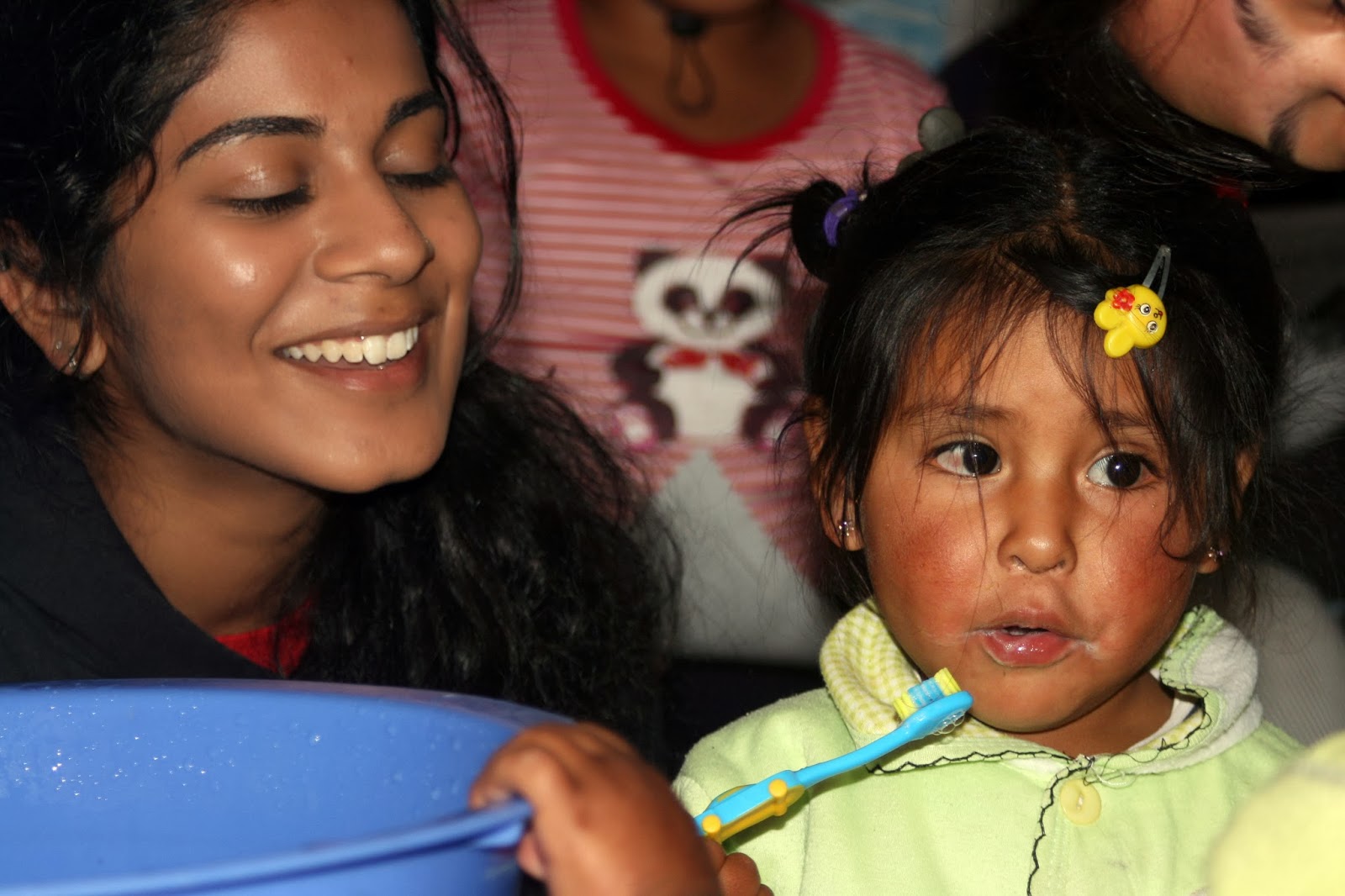
The PHWB team organized children's health education activities at the community health clinic, municipal building, and community meetings.   Stephanie O. and Priya facilitated four workshops reaching over a hundred children.  Using songs, games, and hands-on practice, they taught children how to properly wash their hands and brush their teeth.  They led children in rousing renditions of "Lava tus manos," an instructional hand washing ditty sung to the tune of La Cucaracha.  Shakira's "Waka Waka" marked the recommended two-minute toothbrushing timeframe, the last noble act of Priya's iPhone before it was stolen.

They also addressed clean water and water conservation, hoping to teach young people about the importance of water. 


This photo shows the last of 10,000 times Stephanie and Priya led children in "Lava tus manos."